Share this post
This is some text inside of a div block.
Copied!


Back to all posts
Demand for experienced executive assistants remains strong, but the skills employers value most are changing.


Published on
August 6, 2026
If you're hiring an executive assistant (EA) today, you've probably noticed the role has changed. Not because it’s become less important, but because the expectations have evolved.
Demand for experienced executive assistants remains strong across Canada, but the qualities employers value most look different than they did even a few years ago.
We've spent nearly four decades recruiting executive support professionals, and this is one of the biggest shifts we've seen. As AI takes on more routine administrative work, organizations are placing even greater value on the qualities technology can't replace. Judgment. Discretion. Executive presence. The ability to build trusted relationships.
Understanding that shift can help you define the role more effectively, ask better interview questions and compete for the strongest talent.
It's easy to assume that because AI can schedule meetings, summarize notes and draft emails, organizations will need fewer executive assistants. In practice, that's not what we're seeing from our clients across the country.
Job Bank Canada continues to project steady demand for executive assistants across much of the country. At the same time, nearly half of Canada's executive assistant workforce was aged 50 or older in 2023, with many expected to retire over the coming years. Technology is changing how the work gets done, but it isn't replacing the need for experienced professionals who can support senior leaders with sound judgment, discretion and organizational insight.
We're seeing the same trend across the searches we lead.
More often, we're seeing organizations hire for what happens beyond the calendar.
Yes, exceptional executive assistants still keep leaders organized. But the strongest candidates also anticipate problems before they arise, manage competing priorities with confidence, communicate effectively with executives and stakeholders and become trusted partners to the leadership team.
Statistics Canada has also found that while routine administrative work is more exposed to automation, employment across broader administrative occupations has continued to grow. The greatest gains have been within larger organizations, where executive support roles often extend well beyond traditional administrative responsibilities.
PwC's 2026 Global AI Jobs Barometer points to the same shift across industries. Jobs that combine AI with human judgment, leadership and relationship-building are growing significantly faster than the overall labour market. Executive assistants fit naturally into that trend.
As AI takes on more routine administrative work, executive assistants have more opportunity to focus on the work that creates the greatest value: supporting decision-makers, navigating complex situations and strengthening relationships across the organization.
One of the biggest misconceptions about executive assistants is that technical skills are what separate good candidates from great ones. They're important, but they're rarely the deciding factor.
When we're interviewing executive assistants, there are five areas that consistently tell us whether someone is ready to support senior leadership. These are also the areas that clients ask us about most often when they're looking for someone who can make an immediate impact.
Can the candidate build credibility with senior leaders? Have they worked confidently with Presidents, CEOs or Boards? Can they act as a trusted gatekeeper while maintaining strong relationships across the organization?
Executive assistants are often trusted with highly sensitive information. We look for examples of sound judgment, discretion and the confidence to raise concerns when something doesn't feel right.
Supporting a Board goes well beyond booking meeting rooms. Strong candidates understand agendas, meeting packages, governance processes, action items and executive follow-up.
Many executive assistants are responsible for travel budgets, executive expenses and financial coordination. Experience managing these responsibilities demonstrates attention to detail and accountability.
The strongest executive assistants often help prepare presentations, speeches, briefing materials and executive communications, requiring strong writing skills and an understanding of how senior leaders communicate.
Once you've identified the skills that matter most, the next challenge is assessing them. That's where behavioural interview questions are especially valuable. Rather than asking candidates what they would do, they reveal how they've handled real situations, giving you a much clearer picture of how they'll support your leaders.
Some of the questions we regularly use include:
These questions encourage candidates to move beyond describing tasks and instead demonstrate how they've applied their skills in real situations.
For a more comprehensive list of interview questions for executive assistants and other administrative professionals, explore our Administrative Support Interview Guide.
Curious what executive assistants expect from a compensation standpoint? Below, we've broken out entry-level, mid-level and senior pay for executive assistants across five major Canadian markets.
To ensure accuracy, this data comes from Payscale, the compensation tool we trust to provide reliable market benchmarks for both candidates and employers.
Keep in mind that salaries can vary heavily based on experience, professional certifications, bilingual requirements, industry and whether the role is remote, hybrid or onsite.
In the table below, we've built entry-level, mid-level and senior ranges around Payscale's published 10th percentile, median and 90th percentile base salary for the role in each city. Total compensation may be higher when employers factor in bonuses, profit sharing or other incentives.
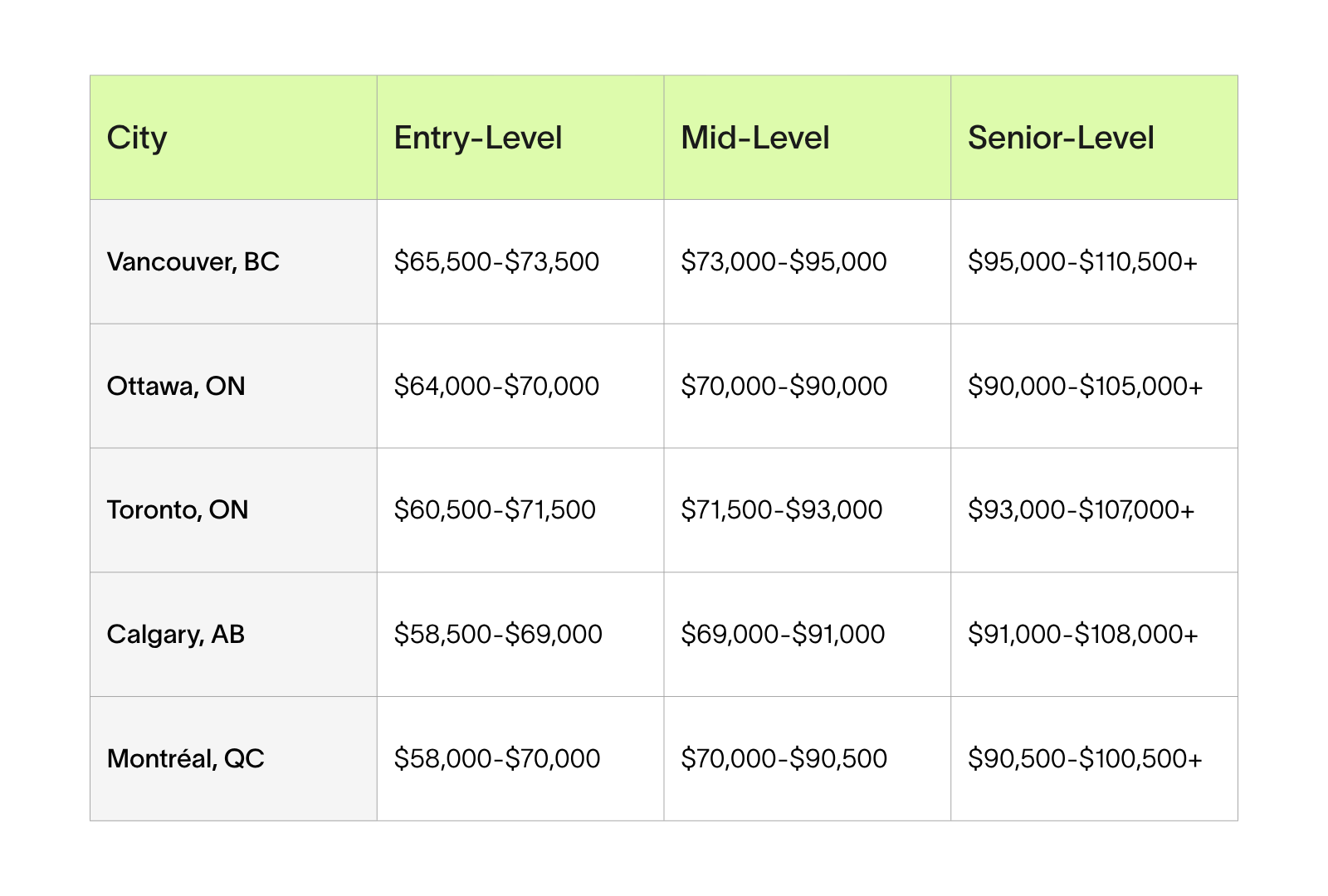
Note: Chief of Staff compensation specifically often runs well above the top of the senior range shown here, since in most organizations it's treated as a distinct, executive role rather than the top of the EA band.
Executive assistants have always created value beyond administration. What's changing is that more organizations are recognizing the impact the role can have.
Research from Harvard Business Review suggests executives supported by strong executive assistants can reclaim as much as 20% of their time for higher-value work. The best executive assistants don't just keep executives organized. They create space for better decisions, stronger leadership and more productive teams.
That's why hiring the right person isn't about finding someone who can manage a calendar. It's about finding someone who can become a trusted extension of your leadership team.
If you're planning to hire an executive assistant this year, we're happy to share what we're seeing in the market, benchmark compensation and help you identify the qualities that make the biggest difference. After nearly four decades recruiting executive support professionals across Canada, we know what separates a good hire from a great one.

Altis is a Canadian-owned staffing firm supporting organizations across the private and public sectors. We focus on relationship-driven recruitment, clear process and consistent delivery, helping employers hire with confidence and professionals build meaningful careers.


.png)