Share this post
This is some text inside of a div block.
Copied!


Back to all posts
How AI can help you find the gaps, strengthen your experience and make your resumé more effective

Published on
November 5, 2026
Updating your resumé isn't always easy. You know what you've accomplished but finding the right words to explain it can be another story. And when you're applying to several jobs, tailoring your resumé for each opportunity takes time.
That's where AI tools like Claude can help. They can review your resumé, compare it with a job posting and help you spot what's missing. They can also help you get started when you're staring at a blank page or struggling to describe your experience.
But there's something worth remembering: the most useful thing Claude can do for your resumé isn't writing it for you; it's helping you communicate your experience more clearly so that a recruiter or hiring manager can quickly understand the knowledge, judgment, skills and accomplishments only you bring to the table.
Used as an editor, Claude can help you identify weak bullet points, missing keywords and unclear phrasing before a recruiter sees your application. But if you simply paste in a job description, ask AI to write your entire resumé and copy whatever comes out, you risk ending up with something that sounds generic and doesn't fully reflect what makes you a strong candidate.
After 37 years of connecting candidates with employers across Canada, we've learned that the strongest resumés are necessarily the most polished. They're the ones that help recruiters understand what you've done, where you've made a meaningful impact and what you could bring to your next role.
Using AI isn't wrong. It can be a valuable tool throughout your job search. The key is making sure your resumé still reflects your actual experience, because that's what will help you stand out.
Ask an AI tool to write your resumé from scratch without providing much detail and it will generally do exactly what you asked, producing something that sounds professional but may not say much about you.
It often reaches for the same familiar phrases like results-oriented, proven track record, leveraged and spearheaded. None of those phrases are bad, but they don't tell a recruiter much about your actual experience. And when several resumés use similar language, it becomes harder to understand what makes each candidate different.
We've seen how AI can make resumés sound polished without necessarily making them more meaningful. In fact, our recruiters share "what makes an AI-assisted resumé stand out (and what makes it sound generic)," along with practical advice for keeping your experience front and centre.
The deeper problem is that AI can't tell you what you actually did. It can smooth out a sentence, but it can't know the number behind "improved efficiency," the specific system you migrated or the client issue you resolved unless you tell it. If you skip straight to a generated draft without adding those important details, you risk skipping past the information that sets you apart.
That doesn't mean you shouldn't use AI to help write your resumé. It can be especially useful if you're struggling to get started, haven't updated your resumé in years or find it difficult to describe your accomplishments. The important part is giving it the right input, reviewing what it produces and making sure the final version still sounds like something you would naturally say.
A strong resumé doesn't need complicated language to make an impression.
When reviewing candidates for a role, recruiters want to understand a few key things: Does your experience match what the employer needs? What did you do in your previous roles? And can you speak confidently about the skills and accomplishments you've included?
Specific details help us answer those questions.
For example, "managed payroll tells a recruiter far less than "processed bi-weekly payroll using ADP Workforce Now, including statutory deductions and year-end reporting."
The second version gives a much clearer picture, even without exaggerated language.
And don't worry if you don't have impressive numbers to include. Not every role has measurable results. The systems you used, the kinds of projects you supported, the people you worked with and the problems you helped solve can be just as useful in helping a recruiter understand what you bring to the table.
This is where Claude can help you uncover details you may not have thought to include.
Want more advice on making your application stand out? Our recruiters share seven practical ways to get noticed by hiring teams.
Instead of only asking Claude to write, ask it to diagnose. It can help you identify what's missing from your resumé before you decide what to change.
Paste in the relevant information and ask Claude to point out what the posting asks for that your resumé doesn't clearly show. This can surface missing keywords and skills you may have but didn't think to mention.
A lot of resumés are full of activity ("managed a team," "handled reporting") without explaining the scope or outcome. Ask Claude to flag bullets that describe what you did but not what happened because you did it. If you don't have a measurable result, you can still add context about your responsibilities, projects or contributions.
Ask it to highlight any line that could apply to almost anyone in your field. That's the line worth making more specific, in your own words.
Formatting, tense, date structure and job title conventions are easy to lose track of across a resumé you've edited a dozen times. This is genuinely a task AI is well suited for, since it's mechanical rather than personal.
If you're unsure where to start with formatting, our guide to resumé best practices in Canada covers the basics, from layout to highlighting your experience.
One of the most useful things you can do is ask Claude to interview you about your resumé rather than simply fix it. Questions like "What's the number behind this bullet?" or "What would someone reading this want to know that isn't here?" can help you uncover stronger examples.
The difference comes down to what you ask for. Prompts that ask Claude to identify gaps can help you strengthen the information before you start rewriting. Once you've answered those questions, you can also ask it to help improve the wording.
Here are a few ways to get more useful responses.
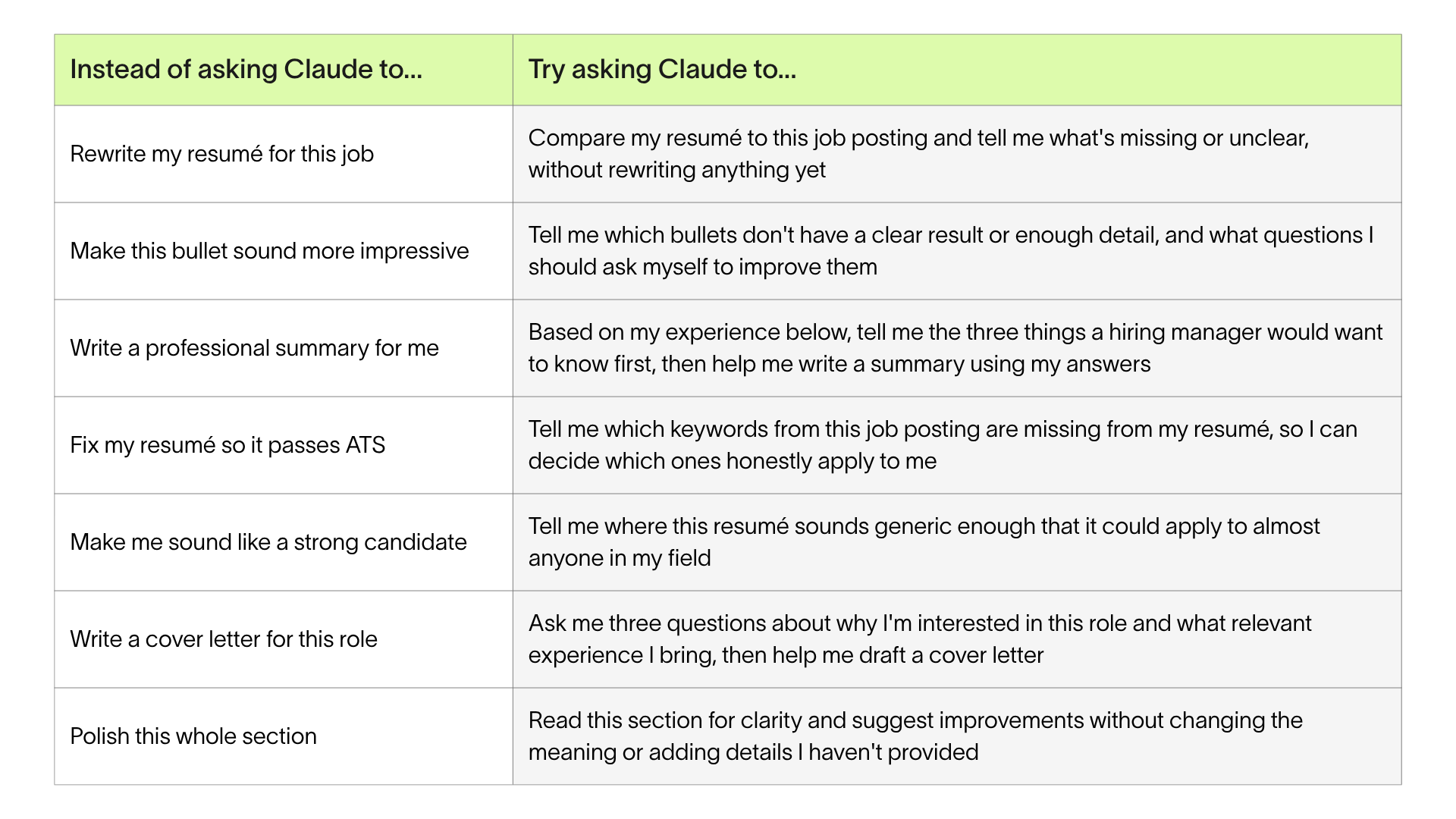
Each of these approaches keeps you involved in the process. Instead of immediately accepting a polished paragraph, you're giving Claude the information it needs to help you produce something more accurate and specific.
And if AI helps you find better wording along the way, that's perfectly fine. Just make sure you're comfortable with the final result.
Short instructions are a good starting point, but the more detail you give Claude about the actual job posting and your actual resumé content, the more useful the gaps it finds will be.
Here's what that looks like in practice for three different roles.
The examples below are illustrative. Any tools, responsibilities or results you include in your own resumé should reflect your actual experience.
A resumé might currently read:
"Processed bi-weekly payroll for staff. Handled employee inquiries and maintained records."
The job posting asks for experience with ADP or Dayforce (formerly Ceridian), familiarity with statutory deductions and remittances and experience supporting audits.
A detailed prompt to Claude might look like this:
"Here's the payroll section of my resumé: [paste bullets]. Here's the job posting for a Payroll Coordinator role I'm applying to: [paste posting]. The posting specifically mentions ADP, statutory remittances and audit support. Go through my bullets and tell me which of these three things I haven't clearly shown, even if you think I might have done them. Don't rewrite anything yet, just tell me what's missing and ask me a specific question about each gap so I can fill it in myself."
Claude might come back asking questions like, "Your resumé doesn't mention which payroll software you used. Was it ADP, Dayforce or something else?" and "You say you handled employee inquiries, but what's an example of a payroll issue you actually resolved, and roughly how many employees were on the payroll you managed?"
Answering those questions is what can turn "processed payroll" into something like:
"Processed bi-weekly payroll for 220 employees in ADP Workforce Now, including statutory remittances and year-end T4 preparation."
The difference is specificity. You're helping a recruiter understand the systems you've used and the scope of your responsibilities, rather than just listing a general task.
A resumé might currently read:
"Managed IT tickets and provided technical support to staff."
The job posting asks for experience with ServiceNow, Active Directory account management, Microsoft 365 administration and a description of ticket volume or SLA performance.
A detailed prompt to Claude might look like this:
"I'm applying for an IT Support Specialist role. Here's the job posting: [paste posting]. Here's my current resumé: [paste resumé]. The posting mentions ServiceNow, Active Directory and Microsoft 365 by name, and asks about SLA performance. My resumé doesn't mention any specific systems or numbers. Ask me what tools I actually used day to day, roughly how many tickets I handled and whether I tracked any resolution time or SLA metrics, so I can add real specifics instead of the generic line I have now."
A useful follow-up from Claude might be asking whether "technical support" meant hands-on hardware troubleshooting, remote software support or both, since those read very differently to a hiring manager, and the current bullet doesn't specify which.
The rewritten version, once you've answered, might land somewhere like:
"Resolved an average of 35 tickets weekly in ServiceNow, managing Active Directory accounts and Microsoft 365 administration for a 200-person organization, maintaining a 95% same-day resolution rate."
If you also have a reliable SLA metric, you could include it. If you don't, there's no need to invent one.
And if the job posting asks for ServiceNow but you've actually used Jira, don't change the name of the software to match the posting. Highlight your experience with Jira instead. Experience with similar systems may still be relevant, particularly when you can explain how your skills would transfer.
A resumé might currently read:
"Managed social media accounts and supported marketing campaigns."
The job posting asks for experience with a content calendar, email marketing (specifically HubSpot or Mailchimp) and comfort reporting on campaign performance using analytics tools.
A detailed prompt to Claude might look like this:
"Here's a job posting for a Marketing Coordinator role: [paste posting]. Here's the marketing section of my resumé: [paste bullets]. The posting specifically asks for HubSpot or Mailchimp experience and comfort with analytics reporting, and my resumé only says I 'managed social media' with no specifics. Ask me which platforms I actually used, whether I tracked any performance metrics like engagement or open rates and whether I managed a content calendar, so I can figure out what to add instead of just making the line sound better."
Claude's follow-up might be asking how many platforms you managed, whether you were building the content calendar yourself or executing someone else's and whether you ever pulled a performance report for a manager or client.
Once answered, "managed social media accounts" can become something like:
"Managed content calendar and posting schedule across four social platforms, and used HubSpot to track email open rates and campaign performance."
If you have measurable results, such as an increase in engagement over a specific period, those can make the bullet even stronger. Just make sure they're based on actual results.
Don't paste a job posting and ask for a "tailored resumé" in one step without reviewing the result. That single prompt can skip the part where you decide, honestly, whether you actually have what the posting is asking for.
Don't accept the first draft as the final version. Whatever Claude generates should be treated as a starting point for you to review, refine and personalize, not automatically as a finished product to submit.
Don't let it invent numbers, tools or outcomes you didn't have. AI can sometimes fill a gap with something plausible-sounding rather than acknowledge that it doesn't know. If a metric shows up that you didn't provide, verify it or remove it.
Don't assume that matching every keyword will get your resumé through an ATS. Applicant tracking systems vary, and no AI tool can guarantee your application will be selected. Focus on including relevant skills and experience naturally, using clear language and straightforward formatting.
Don't ask it to make you sound "more impressive" without giving it any detail. That instruction can produce buzzwords. Ask it to make you sound more specific instead, which produces something closer to your actual experience.
Don't overlook your privacy. Before sharing your resumé with an AI tool, consider removing personal details like your home address, phone number and email. Avoid including confidential information about your current or previous employers or clients. It's also worth checking the tool's privacy settings and data policies before uploading documents.
Don't skip reading the final version out loud. This is one of the fastest ways to catch a line that technically makes sense but doesn't sound like you.
Don't submit anything you couldn't explain in an interview. If a recruiter asked you to walk through any line on your resumé, you should be able to explain what you did and the experience behind it.
Once Claude has flagged a gap or a vague line, the fix should come from you. A useful habit is to answer the questions Claude asks in your own words before looking at any suggested phrasing. From there, you can absolutely use AI to help make your writing clearer or more concise.
Read the finished bullet out loud. If it doesn't sound like something you'd actually say in an interview, it may need another edit, no matter how polished it looks on the page.
It also helps to keep specific, personal details in every section, the kind of things only you would know: the actual name of the system you used, the size of the team, the type of project or the problem you helped solve. Those details are often what generic AI writing leaves out, and they're one of the best ways to make a resumé unmistakably yours.
Is it okay to use AI to write my resumé?
Yes. AI tools like Claude can help you draft, edit and tailor your resumé. The important part is reviewing the final version to make sure it accurately reflects your skills, experience and accomplishments. You should also follow any specific instructions provided by the employer.
Can Claude help tailor my resumé to a job posting?
Yes. You can ask Claude to compare your resumé with a job posting and highlight skills, experience or qualifications that aren't clearly reflected. This can help you decide which relevant details to add, without including anything that doesn't accurately describe your background.
Will employers know if I used AI to write my resumé?
Not necessarily. AI-generated writing can't always be reliably distinguished from human writing, and different employers have different expectations about AI use. Rather than worrying about whether someone can detect AI, focus on whether your resumé is accurate, specific and something you can confidently discuss in an interview.
How can I use AI to improve my resumé for applicant tracking systems?
Ask AI to identify relevant keywords and skills from the job posting that aren't clearly reflected in your resumé. Use that information to highlight experience you actually have, rather than adding keywords just to match the posting. Keep your formatting simple and remember that no prompt guarantees your resumé will pass an ATS.
It's "Can I confidently explain every line of this resumé in an interview?"
Recruiters and hiring managers want to understand your actual experience, not just read a polished description of it. A resumé that sounds impressive but doesn't hold up under follow-up questions isn't doing you any favours. And if you've used Claude or another AI tool to help you organize your thoughts, improve your wording or identify experience you forgot to mention, that's a reasonable way to use the technology.
What matters is that the final resumé accurately reflects your skills, accomplishments and potential.
Used this way, Claude becomes less of a shortcut and more of a helpful editor who happens to have read a thousand job postings, one that's very good at telling you what's missing and staying quiet about what you should actually say instead.
Our team has decades of experience helping candidates across Canada find meaningful work. We know that your resumé is just one part of your career story, and we're here to help you navigate what's next.
And when you're ready for the next step, here's how to use AI to prepare for an interview without sounding scripted.
Ready to put your updated resumé to work? Explore our current job opportunities and find a role that fits your skills, experience and career goals.

Altis is a Canadian-owned staffing firm supporting organizations across the private and public sectors. We focus on relationship-driven recruitment, clear process and consistent delivery, helping employers hire with confidence and professionals build meaningful careers.