Share this post
This is some text inside of a div block.
Copied!


Back to all posts
A guide to Canadian work permits in 2026: permit types, timelines and what employers need to have in place.
Published on
August 19, 2026
Work authorization used to be one of those hiring questions everyone assumed was simple. Ask if someone is legally allowed to work in Canada, get a yes, move on to the offer letter.
That's changed. Immigration targets have shifted, scrutiny has increased and the rules around work permits, maintained status and employer compliance are affecting hiring decisions in ways a lot of employers haven't caught up with yet.
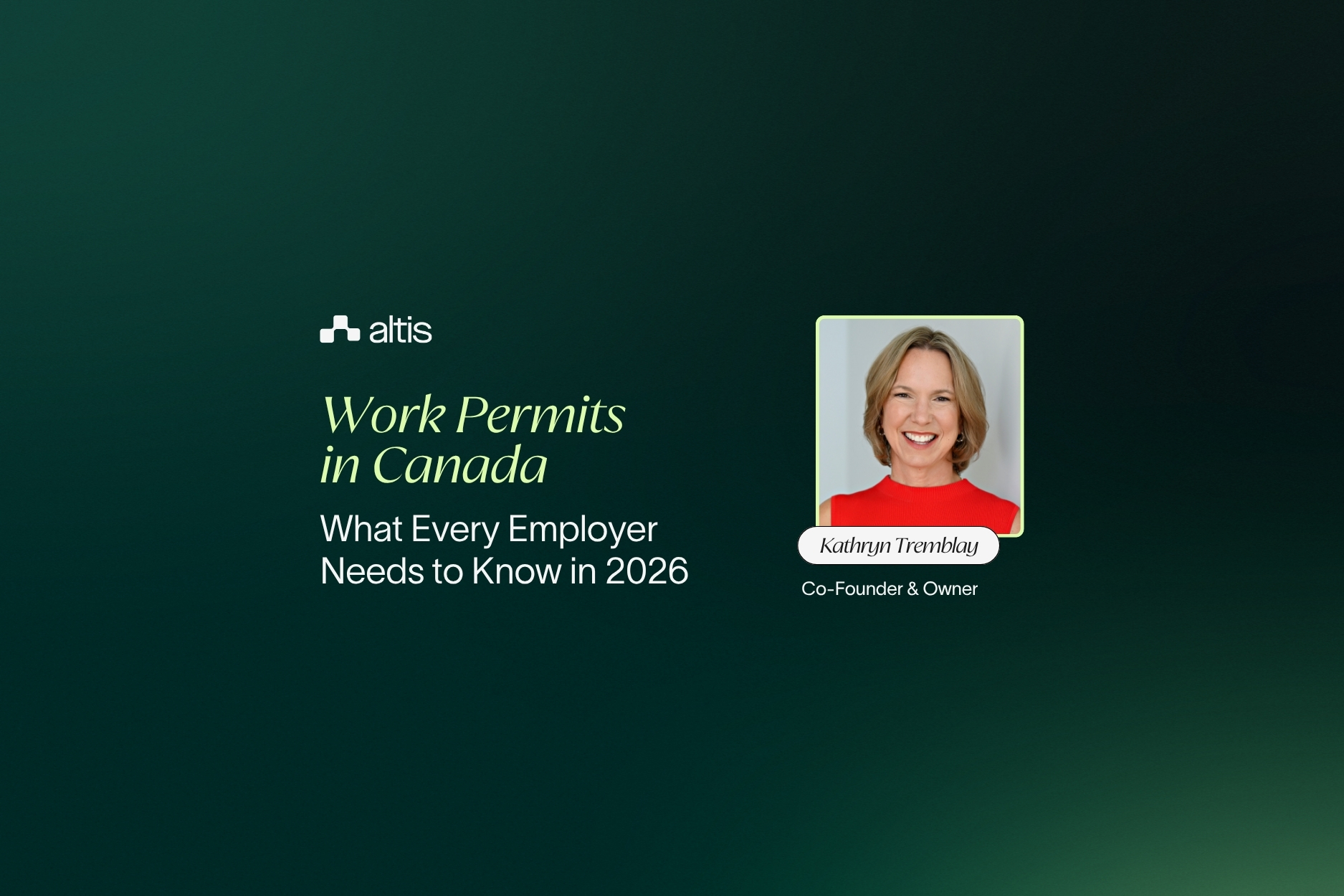
We sat down with Altis co-founder Kathryn Tremblay to unpack what's changing, why it's changing and what employers should actually be doing about it, including a situation Altis experienced firsthand.
Watch the full webinar recording here:
This discussion is for general information only and isn't legal advice. For questions specific to your organization's employment or immigration situation, please consult legal counsel.
If you'd rather read through the conversation, here it is below.
Morgan: Today we're talking about work authorization in Canada. If you're an employer, HR leader or hiring manager, you've probably noticed this has become a much bigger conversation over the last couple of years. There have been significant changes to temporary resident programs, work permits and immigration targets, and those changes are starting to have real implications for employers and employees. So let's start there. Why did you want to have this conversation now?
Kathryn: Because there's a lot changing in this area. Our clients are raising the issue and many are tackling it differently from each other. I was trying to think of ways to make a webinar about work permits fascinating, riveting even. But I can fill you in on what we're seeing and hearing from clients, HR leaders, immigration lawyers and employment lawyers.
Morgan: And this isn't just something you've been hearing about from clients. Altis actually experienced some of these changes firsthand, didn't you?
Kathryn: We did. At Altis, we care deeply about the successful integration of newcomers into Canada and we've invested to be part of that solution. But it's become more complex.
Historically, employers have generally asked a very straightforward question: "Are you legally authorized to work in Canada?" And if the answer was yes, it was yes.
But here's the problem. A Canadian citizen, a permanent resident, someone with an open work permit, someone with an employer-specific work permit and someone working under maintained status can potentially all answer yes. And yet those situations can have very different implications for an employer.
We experienced that ourselves. In December 2025, three of our own permanent internal employees weren't able to obtain extensions to their work permits. Suddenly our AR expert, our Contract Success Specialist and one of our IT engineers could no longer continue working with us.
Ouch. These were valued permanent employees. We felt their loss.
And I'm not dissing our government for creating restrictions. We understand what's behind them. The temporary resident population grew very quickly and Canada has been trying to figure out how to balance immigration with housing, infrastructure, labour market needs and successful integration.
Morgan: When you say it grew quickly, how quickly? What do the numbers actually look like?
Kathryn: Here's a number that really puts the shift into perspective. As of July 2025, Canada had approximately 3 million non-permanent residents, representing about 7% of the population. The federal government's stated objective is to bring that below 5% by the end of 2027.
The 2026 to 2028 Immigration Levels Plan is quite deliberate about reducing the flow of new temporary residents. The target is 385,000 new temporary resident arrivals in 2026, dropping to 370,000 in 2027 and again in 2028. Of the 2027 target, 220,000 are workers and 150,000 are international students.
So yes, we're feeling the pinch. For many people this isn't just a permit. They've built a life here: jobs, friends, communities. So there's a very human side to all of this.
Morgan: And I think that leads to the obvious question. Why is Canada doing this? What's behind all of these restrictions?
Kathryn: There isn't one reason. It's really a combination of housing, pressure on public services, program integrity, labour market needs and sustainability.
Housing is probably the easiest one on our minds. Canada already had a housing shortage and then we experienced very rapid population growth. More people competing for limited housing puts additional pressure on rents and prices. When the government originally announced its reductions in immigration targets, it estimated the changes could reduce Canada's housing supply gap by about 670,000 units by 2027.
Then there are public services. Population can grow quickly. Hospitals, doctors, nurses, teachers, classrooms, transit systems and language programs generally cannot grow at quite the same speed. You can't order 500 family doctors on Amazon and have them arrive Tuesday.
Then there's program integrity. When programs expand quickly, government also wants to make sure they're being used for the purpose they were designed for. We've seen increased scrutiny of international students, temporary foreign workers, employers, educational institutions and immigration representatives, and there have been some very public examples of fraud.
Morgan: Okay so housing, settlement services, education and medical. Is that it for reasons, and are you suggesting immigration isn't as important anymore?
Kathryn: Then there's the labour market. Canada still needs immigration, absolutely. Immigration has accounted for almost 100% of Canada's labour force growth and we have an aging population. Canada's worker to retiree ratio is projected to move from about seven workers for every retiree 50 years ago to roughly two workers for every retiree by 2035.
And we know there are genuine shortages in areas like healthcare and skilled trades, and from my experience, specialized professional roles too: finance, IT, cyber and really any area where you're looking for very specialized skills.
So the question isn't simply "do we need foreign workers." We do. The question is becoming much more targeted: where do we need them, in what occupations, in what regions and for how long. That's why we're seeing immigration policy tied more closely to occupations, industries and demonstrated labour shortages.
In fact, while the government is reducing overall temporary resident arrivals, economic immigration remains the largest component of permanent immigration. By 2027 it's targeted to represent about 64% of permanent resident admissions.
And finally, there's sustainability. The conversation has shifted from "how many people does Canada need" to "how many people can we successfully welcome, where do we need them and how quickly can our communities realistically grow."
Whatever your personal view of the policies, for employers the message is fairly clear. The rules have changed, the scrutiny has increased and we need to plan accordingly.
Morgan: And Canada isn't the only country having this conversation, is it?
Kathryn: No, not at all. Australia, the United Kingdom, New Zealand, Germany, the United States and others have all introduced immigration reforms in recent years, part of a broader international shift toward greater oversight, verification and workforce planning.
Morgan: You've mentioned increased scrutiny a few times. Why has that become such a big part of the conversation?
Kathryn: Temporary resident programs grew very quickly and that brought greater attention to how some programs were operating. One well-known example was the fraudulent letters of acceptance involving international students. Federal officials initially examined more than 2,000 cases, and importantly, many of the students were ultimately considered potential victims themselves. But the situation exposed weaknesses around educational institutions, immigration representatives, verification and accountability.
There's also been another important development. Bill C-12, the Strengthening Canada's Immigration System and Borders Act, received Royal Assent in March 2026, so it's now law, introducing measures aimed at strengthening the integrity of the immigration and asylum systems.
For employers, we don't need to get buried in the politics or legislation today. What matters is the direction of travel: more verification, more documentation, more accountability. And that affects applicants and employers.
Morgan: So let's bring this directly back to employers. Is work authorization becoming more than just a recruitment or onboarding issue?
Kathryn: Absolutely, and this is probably one of the biggest things I want employers to take away today. Work authorization isn't something we can think about only at the hiring stage anymore. It's becoming part of workforce planning.
Imagine this. You've found a great candidate. They accept a permanent role. The hiring manager is excited. Equipment gets ordered. Payroll is set up. Maybe the welcome announcement has already gone out.
And then somebody realizes the person's work permit expires in eight weeks. Or their permit is actually tied to another employer. Or they're working under maintained status while waiting for a decision.
Nobody necessarily did anything wrong. The problem is that the right questions weren't asked early enough.
And I want to be very clear here. This isn't about someone's nationality, race, ethnicity or where they were born. It's about whether that person is legally authorized to perform the work you're offering, and whether there are conditions attached to that authorization that could affect the employment relationship.
Morgan: And that's where I think a lot of employers hesitate. They need to know someone's work authorization, but they also don't want to ask something they shouldn't. So what should employers actually be asking?
Kathryn: Historically, many organizations asked "are you legally entitled to work in Canada." Others asked "are you legally entitled to work in Canada without the need for sponsorship now or in the future."
But immigration counsel have pointed out that these questions don't always give employers all the information they think they're getting. Someone on maintained status, for example, may quite legitimately answer yes while IRCC is considering their application.
A more useful question might be: "Are you legally authorized to work in Canada in this position, including the job, location, hours, industry and expected duration, and are there any conditions or expiry dates associated with your work authorization that could affect your employment?"
It's an important difference. We're focusing on the authorization required to perform the job, not on where someone was born.
And a very important reminder: ask the appropriate question consistently of all candidates. Don't look at someone's name or listen to their accent and decide you need to ask this person a few more questions. Fair and equitable means having a consistent process. Same process for everyone.
Morgan: Right, you mentioned maintained status. Some people may actually remember it by its old name, implied status. What is maintained status and why does it matter to an employer?
Kathryn: Maintained status, formerly called implied status, is one of the areas that causes the most confusion for employers. IRCC now calls it maintained status and frankly the new name is more accurate. Nothing is being implied.
If someone applies properly before their permit expires and meets the requirements, the law can maintain their existing status while IRCC makes a decision. And the important word there is maintained. Not upgraded. Not renewed. And definitely not guaranteed. It maintains what they were already authorized to do while a decision is pending.
So employers shouldn't stop at "are you on maintained status." We need to understand: what authorization did you have before, what application is pending, when was it submitted and under what conditions are you currently permitted to work. Because maintained status tells us a decision is pending. It doesn't tell us what that decision will be.
Morgan: And there's a travel issue with maintained status too, right? That's probably one employers wouldn't immediately think about.
Kathryn: Exactly, and it's a really important practical issue. If a worker leaves Canada while working under maintained status, IRCC says they lose their ability to work when they return to Canada. They generally can't resume working until their work permit application is approved. That's a pretty important detail if somebody casually tells their manager on Thursday that they're flying internationally for the weekend.
Morgan: What about the employer side? Are employers themselves facing more scrutiny?
Kathryn: They are, and there are some pretty striking numbers here. Between April 1, 2025 and March 31, 2026, the Temporary Foreign Worker Program finalized 1,488 employer compliance inspections. Twelve percent of the employers inspected were found non-compliant. More than $10.2 million in penalties were issued. And 30 employers were banned from participating in the program.
Those inspections can examine whether the employee is actually doing the authorized work, whether wages and working conditions match what was approved, whether appropriate documentation has been maintained and whether the employer has met the requirements of the program. Officers may also speak directly with employees.
So the message here is that good intentions aren't a compliance system. Good documentation and good processes matter.
Morgan: So what are employers doing differently? What are you actually seeing clients put in place?
Kathryn: We're seeing organizations strengthen their internal processes. That might mean recording work authorization expiry dates and setting reminders 90 to 120 days in advance. It might mean keeping appropriate documentation for temporary workers, separately tracking employees on maintained status and periodically reviewing authorization records.
Some of our larger clients ask employees on temporary work permits to provide periodic confirmation from their IRCC portal showing the date and status of their application. Is a screenshot perfect evidence? No. Screenshots can be altered, and we've actually encountered an instance where someone attempted to alter work authorization documentation to obtain employment. But for some employers, periodic confirmation is simply another layer in their process. The goal isn't to create a giant new administrative burden, it's to make sure somebody owns this.
We're also seeing employers consider work authorization disclosure language in employment agreements or onboarding documentation, to create transparency and shared accountability. For example:
The Employee represents that they are legally authorized to work in Canada at the commencement of employment.
The Employee agrees to promptly notify the Employer of any change to their work authorization, work permit conditions, restrictions, renewal applications, refusals, expiries, cancellations, or other circumstances that may affect their legal ability to work in Canada.
The Employee agrees to provide updated documentation confirming their work authorization upon reasonable request by the Employer.
Failure to maintain legal authorization to work in Canada, or failure to disclose changes affecting that authorization, may affect the Employee's ability to continue employment.
Of course, organizations should get legal advice before adding language like this to an employment agreement. But the principle is useful. The earlier everybody knows there's a potential issue, the more options you have.
Many clients have said their legal counsel has always told them to ask only whether someone is legally entitled to work in Canada, and we understand that. But we're seeing this evolve in real time, one employer at a time. Employers still want to fully respect human rights. They also have a very practical responsibility to do workforce planning. Those two things don't have to be in conflict.
Morgan: Let's stay with that for a minute, because I think human rights and fair hiring are probably on a lot of employers' minds. How do employers get the information they legitimately need without crossing that line?
Kathryn: Nobody wants a conversation about work authorization to turn into discrimination. For example, perhaps someone is being hired to work in a hospital, but their permit has a condition restricting work in healthcare because the required immigration medical examination hasn't been completed. Or you're hiring someone for a ten-month assignment and their current work authorization expires in ten weeks. That's relevant information.
So keep the conversation focused on employment eligibility and the requirements of the role. Handled properly, these conversations can help employers meet their obligations without creating unnecessary barriers for candidates.
Morgan: We've talked a lot about what's happening now. If I'm an employer looking ahead to 2027 and beyond, what should I be watching?
Kathryn: If the last few years have taught employers anything, it's that immigration programs are definitely not static. They change, and lately they can change rather quickly.
As we move toward 2027, employers should continue watching temporary resident targets, post-graduation work permit rules, pathways to permanent residence, targeted programs for occupations experiencing labour shortages and continued compliance and audit activity. Because managing work authorization is becoming less of an occasional HR administrative task and more of an ongoing operational responsibility.
Morgan: And since AI has already made an appearance in our conversation, let's bring it back to something very practical. Could AI actually help employers manage some of this?
Kathryn: I think this is a really interesting area to watch. As HR technology evolves, AI could potentially support some of the administrative side of work authorization management. Technology could identify permits approaching expiry, remind employees and managers about dates, flag missing documentation, identify files that require follow-up, organize records and help prepare for audits.
AI may also eventually help summarize permit conditions for administrative review, although obviously that needs to be handled carefully. AI should never replace immigration or employment legal advice, professional judgment or human decision-making. But it can help us spot things earlier.
Think about what payroll technology did for tax remittances, deadlines and compliance. Eventually AI and HR systems may do something similar with work authorization: this permit expires in 120 days, somebody needs to look at this. Not terribly glamorous. But neither is discovering on Monday morning that somebody can't legally work.
Morgan: That's probably a good place to bring everything together. We've covered a lot. If an employer remembers just a couple of things from this conversation, what do you want them walking away with?
Kathryn: I'll leave you with this. For years employers could ask "are you legally authorized to work in Canada." That question still matters. It's just no longer enough on its own.
The goal isn't to create barriers for candidates. And it certainly isn't to make it harder for talented newcomers to build careers in Canada. The goal is to understand the work authorization attached to the employment relationship, identify issues early and plan ahead.
Because ultimately, for an employer, I think this comes down to two very simple questions: Can this person legally perform the work we're offering today? And do we have a plan for tomorrow?
If you can confidently answer both, you're in a much better position. And if you can't answer the second one yet, don't wait until eight weeks before the permit expires to start asking.
Work authorization isn't just a hiring question anymore. It's a workforce planning question. Ask earlier. Track better. Communicate openly. And when the situation isn't clear, get good advice.
Morgan: I think that's a perfect place to end. This really isn't about making hiring more difficult. It's about asking better questions earlier, planning ahead and making sure both employers and employees understand what may be coming. Thank you so much, and thank you to everyone who joined us today.
Kathryn: Thank you very much for joining us.

Altis is a Canadian-owned staffing firm supporting organizations across the private and public sectors. We focus on relationship-driven recruitment, clear process and consistent delivery, helping employers hire with confidence and professionals build meaningful careers.