Share this post
This is some text inside of a div block.
Copied!


Back to all posts
Learn how much notice to give, what to include in your resignation letter, how to leave on good terms and what to consider before accepting a counteroffer.

Published on
October 1, 2026
Accepting a new opportunity may feel like the finish line in a job search, but how you leave your current role matters too. The people you work with today could become future references, clients, colleagues, hiring managers or even business partners. Professional networks often reconnect in unexpected ways.
That doesn’t mean you need to pretend that every part of the experience was positive. Even if you’re ready to move on, you can leave in a way that protects your reputation, respects the relationships you’ve built and gives everyone clarity about what happens next.
We’ve seen plenty of careers come full circle over the years. Former managers become references. Former colleagues become clients. People leave organizations and return later in a completely different role. A thoughtful exit helps keep the doors open.
In this guide, we’ll walk through how to prepare for the conversation, write your resignation letter, handle your notice period and think through a counteroffer if one comes your way.
You may be more than ready to leave your current job behind, but before you schedule the conversation, make sure you’re prepared for what could happen next.
Once you resign, things can move quickly. Your employer may want you to work through your full notice period, or, depending on your role and workplace, they may decide your last day will be sooner.
This isn’t always a negative reaction to your resignation. In some positions, particularly those involving sensitive information, client relationships or system access, an earlier departure may simply be part of the employer’s normal process. What happens with your employment status and pay in that situation can depend on the circumstances and applicable employment laws, so ask for clarity about your final day, pay and benefits.
In other circumstances, an employee may choose to provide less notice than requested or required. The practical implications can depend on the employment agreement and applicable law.
Before you give notice:
You may also want to save personal employment records, such as pay statements or benefit information, if you’re permitted to do so. However, never copy or take confidential company files, client information, internal documents or other material that belong to the company.
A resignation letter is a written record confirming that you’ve chosen to leave your position.
It should clearly state that you’re resigning, confirm your position and provide your intended final day. It also gives both you and your employer a written record of what was communicated and helps the offboarding process get started.
Even in workplaces where communication is fairly informal, written notice is still useful. In most cases, it should follow a verbal conversation with your manager.
Your resignation letter doesn’t need to explain every reason behind your decision. It’s a formal notice, not an exit interview. A few clear paragraphs are usually enough.
Whenever it’s safe and practical, speak with your manager privately before sharing the news with colleagues.
If you work on-site, that may mean an in-person conversation. If you work remotely, a video or phone call is usually appropriate.
You don’t need a long speech.
Try something like:
“I wanted to let you know that I’ve decided to resign from my position. I’m grateful for what I’ve learned here and I’d like to help make the transition as smooth as possible. My intended final day is [date].”
Give a specific date rather than simply saying you’re giving “two weeks’ notice.” That removes any uncertainty about timing.
Your manager may ask why you’re leaving or where you’re going. You only need to share what you’re comfortable sharing. A simple response such as, “I’ve accepted an opportunity that feels like the right next step for me,” is often enough.
Send your resignation letter or email shortly after the conversation, ideally on the same day. Keep a copy for your records.
Ask your manager how and when they would like your departure communicated to the broader team.
Give them time to plan the announcement before speaking with clients, external partners or colleagues unless you’ve agreed otherwise.
Stay engaged, complete your most important work to the best of your ability and leave clear notes for whoever takes over your responsibilities.
You don’t need to solve every problem before you leave. The goal is to leave your work in a state that someone else can reasonably understand and pick up.
Careers are rarely as linear as they look on paper.
Someone you work with today may recommend you for a role five years from now. A former manager may become a client. A teammate may end up leading a company you want to join.
That’s why we encourage candidates to think of resignation as more than an administrative step. You’re closing one professional relationship while beginning another. Handling both with care can pay off in ways you may not see immediately.
Two weeks is common practice, but it isn’t a universal legal rule across Canada.
The amount and form of notice you may need to provide can depend on where you work, whether your workplace is federally regulated, your employment agreement, a collective agreement, employment standards legislation and your individual circumstances.
Senior leaders, executives and employees in highly specialized roles may also have contractual requirements for longer notice.
The practical takeaway is simple: don’t choose your last day based on a rule of thumb. Check what applies to your role before you resign. You may choose to offer more notice as a courtesy to your employer.
A strong resignation letter usually needs five things:
A clear statement that you’re resigning
Avoid vague language such as, “I think it may be time for me to move on.”
Your current position and employer
This is particularly helpful in larger organizations.
Your intended final day of work
Use a specific date.
A brief expression of appreciation, if it feels appropriate
This can be warm or neutral depending on your experience.
A realistic offer to support the transition
You can offer to document your work, prepare handover notes or help with priority items during your remaining time.
You can also include a brief reason for leaving or personal contact information if you choose.
A resignation letter generally isn’t the place for:
If the experience was difficult, brief and neutral wording is often more professional than praise you don’t actually mean.
Usually, not much.
You don’t need to provide a detailed explanation in your resignation letter. If you want to include a reason, one sentence is often enough.
Here are some common reasons and example explanations:
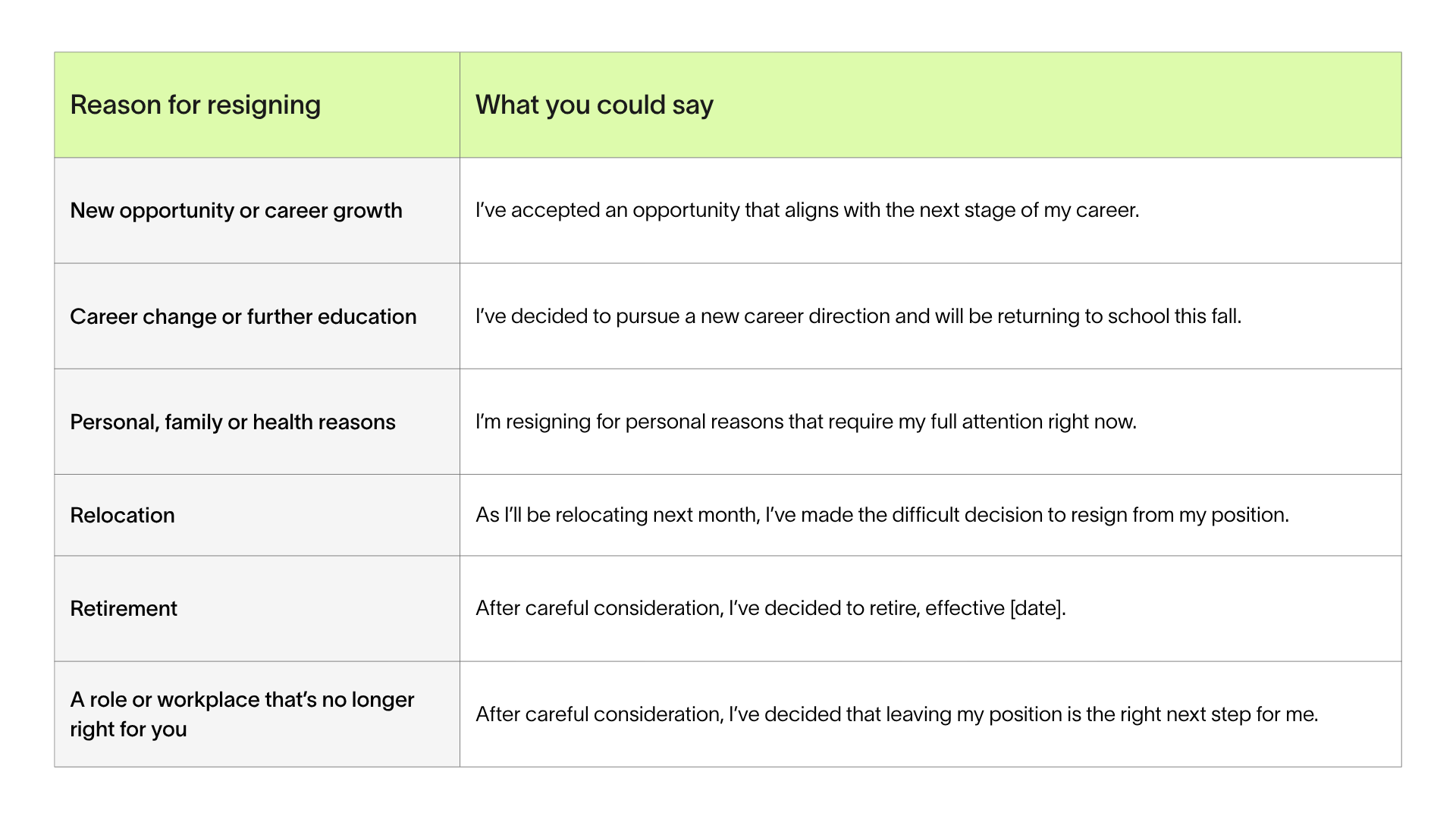
Use this as a starting point, then adjust the tone and level of detail to match your role and relationship with your manager.
Subject: Resignation - [Your full name]
Hi [Manager’s name],
Please accept this [letter/email] as formal notice of my resignation from my position as [job title] with [company]. My final day of work will be [date].
[Optional brief reason for leaving.]
I appreciate [specific but concise expression of gratitude]. During my remaining time, I’ll do what I can to document my responsibilities and support a smooth transition.
Thank you for the opportunity to be part of [company/team].
Sincerely,
[Your name]
[Personal contact information, if needed]
This style works well for many employees, particularly when they have a positive relationship with their manager:
Subject: Resignation – John Doe
Hi Mark,
As we discussed, I’m resigning from my position as Project Coordinator with Bay and Lake Group. My final day will be Friday, October 23, 2026.
I’ve accepted an opportunity that will allow me to take on a new challenge and continue growing in my career. This wasn’t an easy decision, and I’m very grateful for the support and experience I’ve gained here.
Over the next two weeks, I’ll update my project notes, organize outstanding work and focus on the handover priorities we agree on.
Thank you again for everything. I’ve really enjoyed being part of the team and hope we can stay in touch.
Sincerely,
John
A senior-level resignation can be slightly more formal and more specific about transition planning while still remaining concise.
September 21, 2026
Jane Lee
Chief Executive Officer
Bay and Bank Group
Dear Jane,
Please accept this letter as formal notice of my resignation from my position as Vice President, Operations with Bay and Bank Group, effective Friday, October 23, 2026.
After careful consideration, I have decided to accept an opportunity that aligns with my long-term professional goals. It has been a privilege to contribute to the organization and work alongside such a dedicated leadership team.
Over the coming weeks, I will focus on completing priority commitments, documenting key responsibilities and supporting a thoughtful transition of my team and stakeholder relationships. I am happy to work with you on a plan that reflects the organization’s most immediate needs.
Thank you for the trust and opportunities I have received during my time here. I wish you and the organization continued success.
Sincerely,
Ann Smith
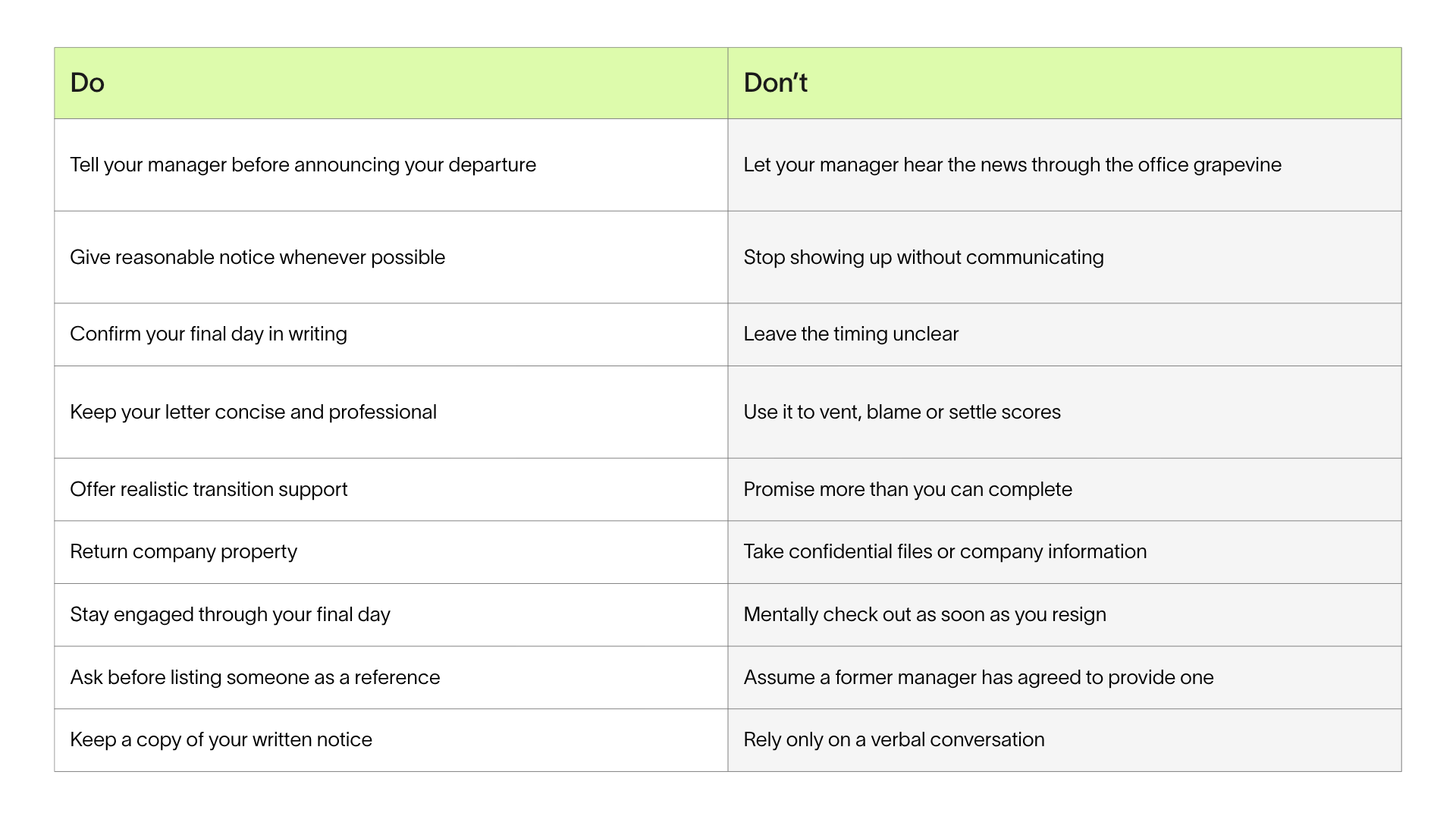
An exit interview is an opportunity to share feedback that may help your employer improve. Many employees worry that being honest will burn a bridge or affect a future reference, but constructive feedback can be delivered professionally and respectfully.
A few tips:
For example, instead of saying, "My manager was disorganized," you could say:
"Priorities changed frequently and were not always communicated clearly, which made it difficult for me to plan my workload. A more consistent process for confirming priorities would have helped."
You can be candid without making the conversation personal. If you need to report a serious concern, consider documenting it through the appropriate channel rather than relying on the exit interview.
A counteroffer is an offer from your current employer intended to persuade you to stay. It might include a raise, promotion, different responsibilities, more flexibility or another change to your employment.
A counteroffer isn’t automatically a good or bad decision. Sometimes it genuinely addresses the reason you were considering leaving. Other times, it changes one part of the job without addressing what led you to look elsewhere.
Before comparing offers, go back to why you started looking in the first place. Consider:
If compensation was your main concern and your employer has genuinely addressed it, staying may make sense. The same can be true if the counteroffer includes meaningful changes to your role, growth or working conditions. If your reasons for leaving go beyond compensation, consider whether those things have changed too.
You don’t need to respond immediately. Thank your employer, ask for the complete offer in writing and give yourself time to consider the full picture, including compensation, benefits, flexibility, growth and what each opportunity could mean for you longer term.
If you’re working with a recruiter, let them know you’ve received a counteroffer. They can help you revisit why you started looking, compare the opportunities and think through the trade-offs without making the decision for you.
The final choice is yours. For more information on negotiation job offers, read: How to Negotiate a Job Offer: Scripts, Tips & Examples.
A written resignation confirms your decision, your intended final day and the notice you provided. Even if you resign verbally first, written confirmation helps prevent misunderstandings.
Two weeks is common, but it isn’t a universal rule. The right amount of notice depends on your agreement, workplace requirements and the laws that apply where you work.
Check before choosing your final day.
When possible, speak with your manager first and send the email afterward.
That said, email is a normal way to provide written notice in many workplaces.
Usually, no detailed explanation is necessary.
If you want to share a reason, keep it brief and focus on your decision rather than listing everything that went wrong.
You can share your next employer if you’re comfortable doing so, but you generally don’t need to volunteer that information.
Review any contractual obligations that may apply to you.
You can ask, but your employer may not agree.
That’s one reason to make sure your decision is final before resigning. Avoid using resignation as a negotiation tactic.
Starting a new opportunity is exciting, but how you close your current chapter matters too.
Be clear about your decision, give reasonable notice, follow through on the transition plan you’ve agreed to and treat the people around you with respect. You can’t control how every employer responds to your resignation. You can control how you handle it.
Once you’ve said your goodbyes, your attention can turn to what’s next. Our guide to your first 90 days in a new job can help you settle in, build strong relationships and start your new role with confidence.
And if you’re working with a recruiter through your job search, keep them in the loop. They can help you think through the resignation process, prepare for a counteroffer and make sense of any questions that come up as you move from one role to the next.
Disclaimer: This article provides general career information and is not legal advice. Employment standards, contracts and individual circumstances can affect your rights and obligations. Always seek qualified advice if you’re unsure how the rules apply to your situation.

Altis is a Canadian-owned staffing firm supporting organizations across the private and public sectors. We focus on relationship-driven recruitment, clear process and consistent delivery, helping employers hire with confidence and professionals build meaningful careers.