Share this post
This is some text inside of a div block.
Copied!


Back to all posts
And which finance and accounting role is right for your business?


Published on
November 13, 2026
Controller or CFO? If you're looking to hire a senior finance professional, you might be wondering which role your business actually needs. While the two titles are sometimes used interchangeably, the jobs themselves are quite different. And knowing the difference can help you make the right hire.
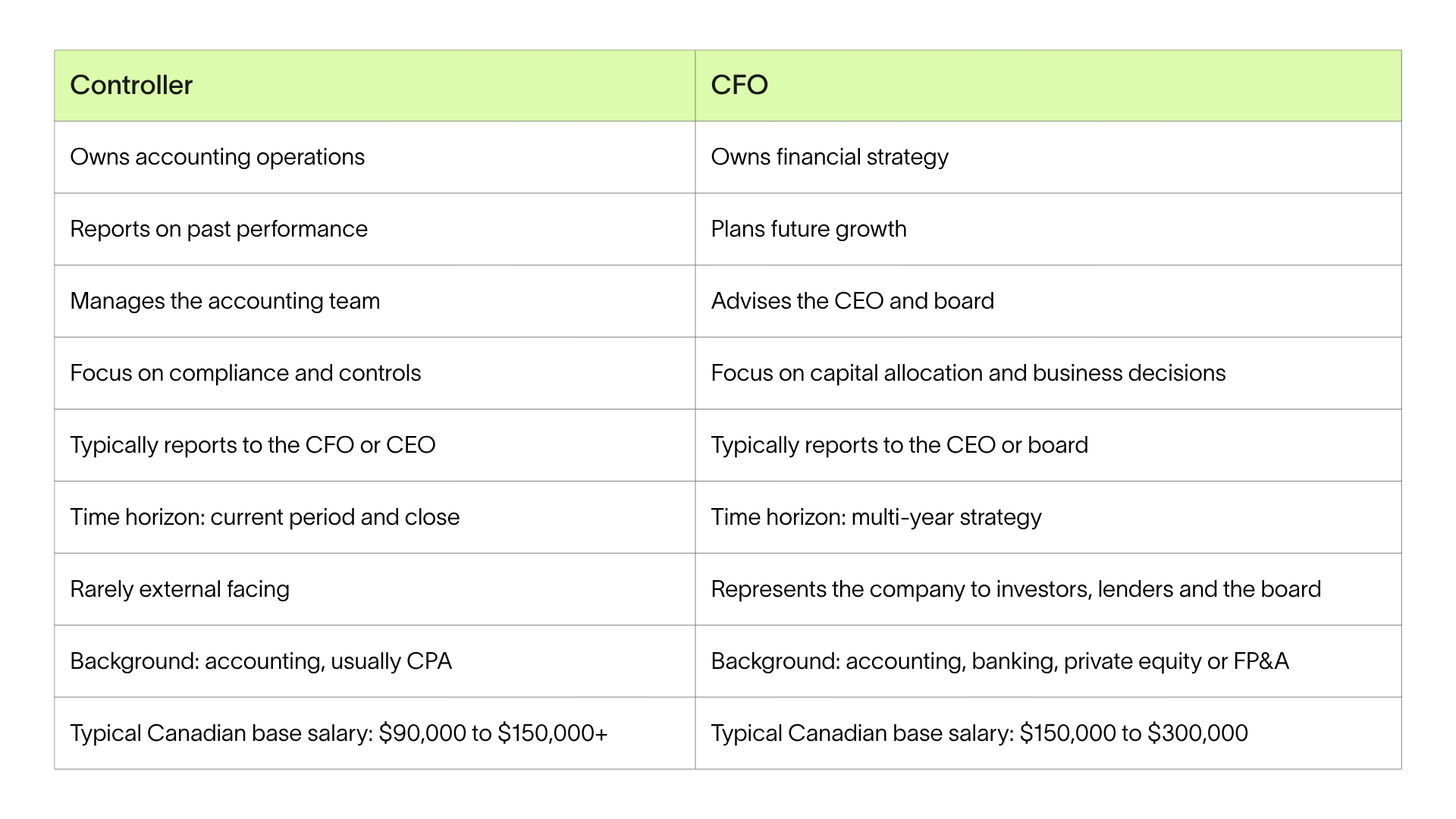
Think of it this way: A Controller keeps your company's finances on track. They oversee the day-to-day accounting, make sure the numbers are accurate and keep everything running smoothly behind the scenes. A Chief Financial Officer (CFO) looks at the bigger picture. They use those numbers to guide business decisions, plan for growth and help shape the company's financial future.
Both play important roles, but they bring different skills to the table. So how do you know which one you need?
Whether you're building out your finance team or deciding which senior role to hire next, understanding what each position brings to your business is a good place to start.
A Controller owns the accuracy of the numbers. That means running the monthly and year end close, maintaining internal controls, managing the accounting team and making sure financial statements hold up to an audit. A Controller is looking backward and inward: what happened, is it recorded correctly and does it match what the policy says it should.
A Controller's typical day might include:
A CFO owns the company's financial future. That means financial strategy, capital allocation, investor and board relationships and long-term risk management. A CFO is looking forward and outward: what should we invest in, how do we fund growth and how do we get buy in from senior leadership.
A CFO's typical day might include:
The difference in one line: A Controller makes sure the numbers are right. A CFO decides what to do with them.
Compensation varies widely by company size, industry and city, but here's a general benchmark based on current Canadian salary data.
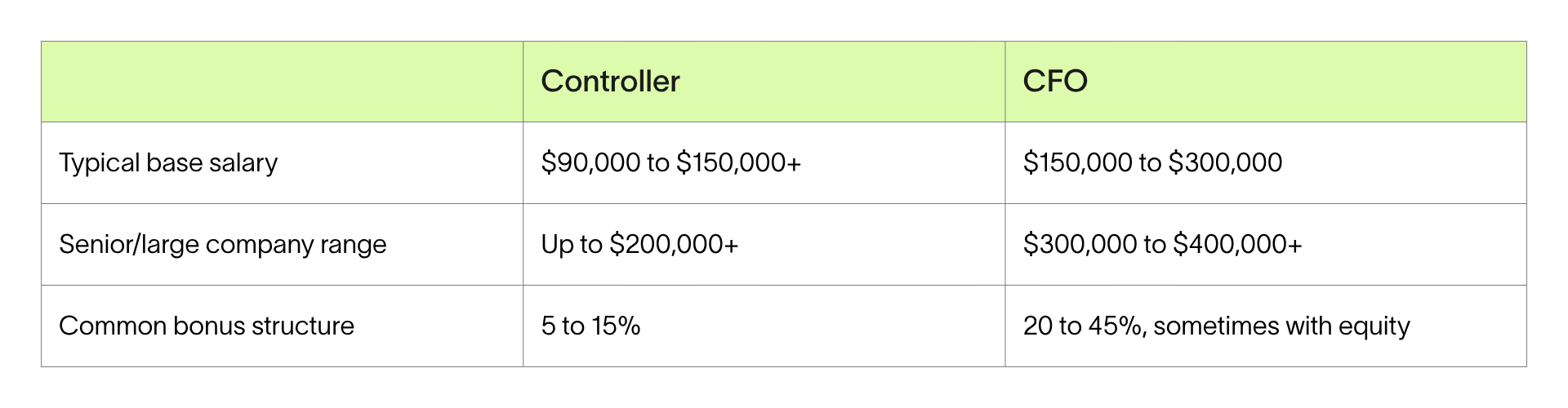
The CFO range is wider because the title covers everything from the first finance hire at a small company to the CFO of a large public organization, and compensation scales accordingly.
Both roles typically require a bachelor's degree in accounting or finance, but the career paths can look quite different from there.
Controller: Most Controllers hold a Chartered Professional Accountant (CPA) designation, given the role's focus on accounting and financial reporting. Many start their careers in public accounting or internal audit before moving into a Controller position.
CFO: A CPA designation is common among CFOs too, but it's not always required. Some come from a background in corporate finance or investment banking, often with an MBA. This is especially true in organizations where the role focuses on business strategy, growth and investment decisions than day-to-day accounting.
Controller: Controllers need strong technical accounting skills, including a solid understanding of accounting standards, financial reporting and internal controls. They're detail-oriented, organized and skilled at spotting errors before they turn into bigger problems.
CFO: CFOs need a broader mix of financial expertise, strategic thinking and people skills. They need to see the bigger picture, understand where the business is headed and communicate confidently with executives, boards and investors. They're also comfortable making tough financial decisions, even when there's no obvious right answer.
There's more than one way to reach either role, but a few patterns show up consistently.
Example Controller career path:
Staff Accountant > Senior Accountant > Assistant Controller > Controller (from here: stays as Controller long-term, or moves into VP of Finance or CFO)
Example CFO career path, through accounting:
Staff Accountant > Senior Accountant > Assistant Controller > Controller > VP of Finance > CFO
Example CFO career path, through investment banking or private equity:
Analyst (investment banking or private equity) > Associate > Vice President (deal or portfolio side) > Director of Corporate Development or Finance > CFO
Example CFO career path, through FP&A:
FP&A Analyst > Senior FP&A Analyst > FP&A Manager > Director of Finance > CFO
The right hire depends on where your business is today and where you're headed next. And with approximately 32,100 job openings projected for financial managers across Canada between 2024 and 2033, it's worth thinking carefully about the skills your business needs. According to Employment and Social Development Canada, an estimated 36,900 job seekers are expected to enter the field over the same period. These projections cover the broader financial manager category, which includes both Controllers and CFOs.
You likely need a Controller if: Your priority is getting the financial fundamentals right. You need someone who can close the books accurately and on time, put reliable internal controls in place, manage your accounting team and produce financial statements you can trust. For many small and growing businesses, a Controller is the right first senior finance hire. It's easy to assume you need a CFO when you don't yet have someone leading your finances, but a Controller may be exactly what your business needs at this stage.
You likely need a CFO if: Your financial decisions are becoming more complex and strategic. Maybe you're looking to raise capital, take on debt, expand into new markets or prepare for an acquisition or sale. You might also need someone to manage relationships with investors or your board. When financial decisions have a significant impact on your company's future, a CFO brings the strategic expertise to help you make them with confidence.
You might need both if: Your business has grown to the point where one person can't effectively manage both responsibilities. Perhaps you hired a Controller early on, and as the business grew, they started taking on more strategic work. At this stage, you might consider promoting them into a CFO role or bringing in a CFO to lead financial strategy while your Controller continues overseeing accounting operations. Having both isn't necessarily about adding another layer of leadership. It's about making sure each person has the time and focus to do their job well.
Once you've determined which role your business needs, the next step is finding the right person. Beyond technical qualifications and experience, you'll want to understand how candidates approach challenges, make decisions and work with others.
Here are some questions to help you get a better sense of whether a candidate is a good fit.
For a Controller candidate:
For a CFO candidate:
A Controller and a CFO may work in the same department, but they serve different purposes. One makes sure your financial information is accurate and reliable, while the other uses that information to help guide your business forward. Understanding what each role brings to the table can help you hire the right person for your business, not just the right job title.
Still not sure which role you need? With more than 37 years of recruitment experience, we've helped businesses of all sizes find the finance and accounting talent they need. Let's chat about what makes sense for your team.
Looking for your next opportunity in finance or accounting? Take a look at some of the roles we're currently hiring for:
Finance Manager, Contract, Hybrid in Vancouver, BC
Controller, Permanent, On-site in Vancouver, BC
Finance Manager, Permanent, On-site in Ottawa, ON
Director of Finance, Permanent, On-site at an agreed office location in Canada
Senior Analyst, Financial Reporting, Contract, Hybrid in Toronto, ON
Executive Director, Finance, Permanent, Hybrid in Kingston, ON
Senior Accountant, Permanent, On-site in Ottawa, ON
Senior FP&A Analyst, Contract, Hybrid in Toronto, ON
Sr. Financial Planning Analyst, Capital Accounting & Planning, Permanent, Hybrid in Toronto, ON
Assistant Vice President, Internal Audit, Permanent, Hybrid in Toronto, ON
Check out more open roles on our Job Portal.

Altis is a Canadian-owned staffing firm supporting organizations across the private and public sectors. We focus on relationship-driven recruitment, clear process and consistent delivery, helping employers hire with confidence and professionals build meaningful careers.