Share this post
This is some text inside of a div block.
Copied!


Back to all posts
Why now is a great time to build or advance your career in insurance, from licensing and designations to in-demand roles and salaries.

Published on
August 24, 2026
What does it take to stand out in a field built on trust, risk, relationships and problem solving?
Behind every well-protected business or family is an insurance professional who can read risk clearly and explain it simply. In this guide, we're breaking down why insurance continues to be a strong career choice, the roles employers are hiring for right now, the courses and certifications that give you an edge and the soft skills that turn technical knowledge into real impact.
If you're looking to grow your insurance career, here's what matters most today.
Insurance touches nearly every part of the economy, and that won’t change anytime soon. Here's why demand for skilled insurance professionals remains strong across the country:
Strong job security. Every business and household needs coverage, which means insurers, brokerages and underwriters need people who can assess risk, write policies and handle claims regardless of what's happening in the broader economy.
A wave of retirement is opening doors. A large share of the industry's workforce is nearing retirement, and that's creating steady demand for new talent, from entry-level roles to leadership.
Higher earning potential with designations. Professionals who pursue a CIP, FCIP or CAIB designation typically see faster advancement and stronger compensation than peers without one.
Career flexibility. Your skills transfer across personal lines, commercial lines, life and health, reinsurance and risk management, and across insurers, brokerages, MGAs and corporate risk teams.
A pathway to leadership. From Underwriter to Claims Manager to VP of Risk, many senior titles in insurance value hands-on experience paired with a recognized designation.
Climate change is reshaping the field. Rising claims tied to severe weather mean insurers need sharper underwriting, catastrophe modelling and claims expertise more than ever, which is opening up newer, more specialized roles.
So if you're aiming for stability, earning power and long-term growth, insurance continues to deliver.
Our recruiters are hiring for a wide range of permanent insurance roles across locations, experience levels and areas of specialization. Here are some of the top opportunities available today:
Standing out in insurance today means going beyond your day-to-day tasks. Along with provincial licensing, these designations and courses can help accelerate your career and open doors to more senior roles:
Licensing and designations open the door, but soft skills are what move you forward. Employers want insurance professionals who can build trust, communicate clearly and make sound judgment calls under pressure. Here's what sets great insurance professionals apart:
Communication
Turning policy language and coverage details into something a client or claimant can actually understand. Example: Walking a policyholder through what's covered after a loss, in plain language, during a stressful moment.
Analytical thinking
Reading risk clearly and making sound judgment calls based on data. Example: Reviewing a commercial applicant's loss history and identifying risk factors a standard checklist would miss.
Attention to detail
Small errors in a policy or claim file can have big consequences down the line. Example: Catching a coverage gap during underwriting before it becomes a costly denied claim.
Empathy
Many conversations in insurance happen when something has gone wrong. How you show up matters. Example: Guiding a family through a home claim after a fire with patience and clear next steps.
Negotiation
Balancing the interests of the insurer, the broker and the client. Example: Settling a claim fairly while keeping the file within policy terms and reserve expectations.
Adaptability
Regulations shift, climate risk evolves and new technology changes how work gets done. Example: Learning a new claims management system during a company-wide rollout and becoming the team's go-to resource.
Ethical judgment and integrity
Insurance runs on trust, and that means doing right by the client even when it's the harder call. Example: Flagging a questionable claim for further review instead of rushing it through to close the file.
Time management
Balancing a full caseload or book of business without letting quality slip. Example: Prioritizing urgent claims while keeping renewals and routine files moving on schedule.
If you're new to insurance or brushing up before an interview, here are some terms worth knowing:
Underwriting: The process of evaluating and pricing risk to decide whether and how to insure it.
Premium: The amount a policyholder pays for coverage.
Claim: A formal request from a policyholder for the insurer to pay out under the terms of a policy.
Broker: A licensed professional who represents the client and shops coverage across multiple insurers.
MGA (Managing General Agent): An intermediary that has been given authority by an insurer to underwrite and bind certain types of business on its behalf.
P&C insurance: Property and casualty insurance, covering things like homes, vehicles and businesses against loss or liability.
Reinsurance: Insurance that insurance companies buy from other insurers to spread out large or catastrophic risk.
Loss ratio: The percentage of premiums an insurer pays out in claims, used to measure how profitable a book of business is.
Adjuster: The professional who investigates a claim, determines what's covered and settles the payout.
Actuary: A professional who uses statistics and financial theory to calculate risk and set pricing.
There's no single way to build a career in insurance, but being intentional can help you grow faster and more thoughtfully.
If you're not sure which direction makes sense, start here:
Look at what energizes you. Do you enjoy assessing risk, resolving claims or building client relationships?
Look at how you think:
Look at the impact you want to have. Some roles are closer to pricing and risk decisions; others are closer to the client relationship. None are better; they're just different.
Below are five common paths we see across the industry today:
1. Underwriting (Risk and pricing focused)
Focus: Risk assessment, pricing, policy terms, portfolio management
Typical path: Underwriting Assistant → Underwriter → Senior Underwriter → Underwriting Manager
If you like analyzing information and making calculated decisions, this path puts you at the center of what gets insured and at what price.
2. Claims (Client facing and investigative)
Focus: Claims investigation, settlement negotiation, fraud detection, customer service
Typical path: Claims Adjuster → Senior Claims Adjuster → Claims Team Lead → Claims Manager
If you enjoy problem solving and supporting people through difficult moments, claims work combines investigation with genuine client care.
3. Brokerage and Client Advisory (Relationship focused)
Focus: Client relationships, coverage placement, account management, business development Typical path: Broker Assistant → Account Executive → Senior Broker → Branch Manager or Principal Broker
If you enjoy building relationships and advising clients directly, broking leans into trust, communication and long-term client partnerships.
4. Customer Care (Client service focused)
Focus: Policy questions, billing support, service requests, day-to-day client communication
Typical path: Customer Care Advisor → Senior Customer Care Advisor → Customer Care Team Lead → Customer Care Manager
This is one of the most common entry points into an insurance career. Customer Care Advisors are the first point of contact for policyholders, handling everything from billing questions to service requests.
5. Licensed Sales (Advisory and sales focused)
Focus: Licensed product advice, quoting and selling coverage, cross selling and upselling, client retention
Typical path: Licensed Sales Advisor → Senior Sales Advisor → Sales Team Lead → Sales Manager
Once you hold your provincial license, this path puts you in front of clients directly, advising on coverage and closing new business. It's a strong fit for people who enjoy sales conversations and want a role where their advice and their results are closely connected.
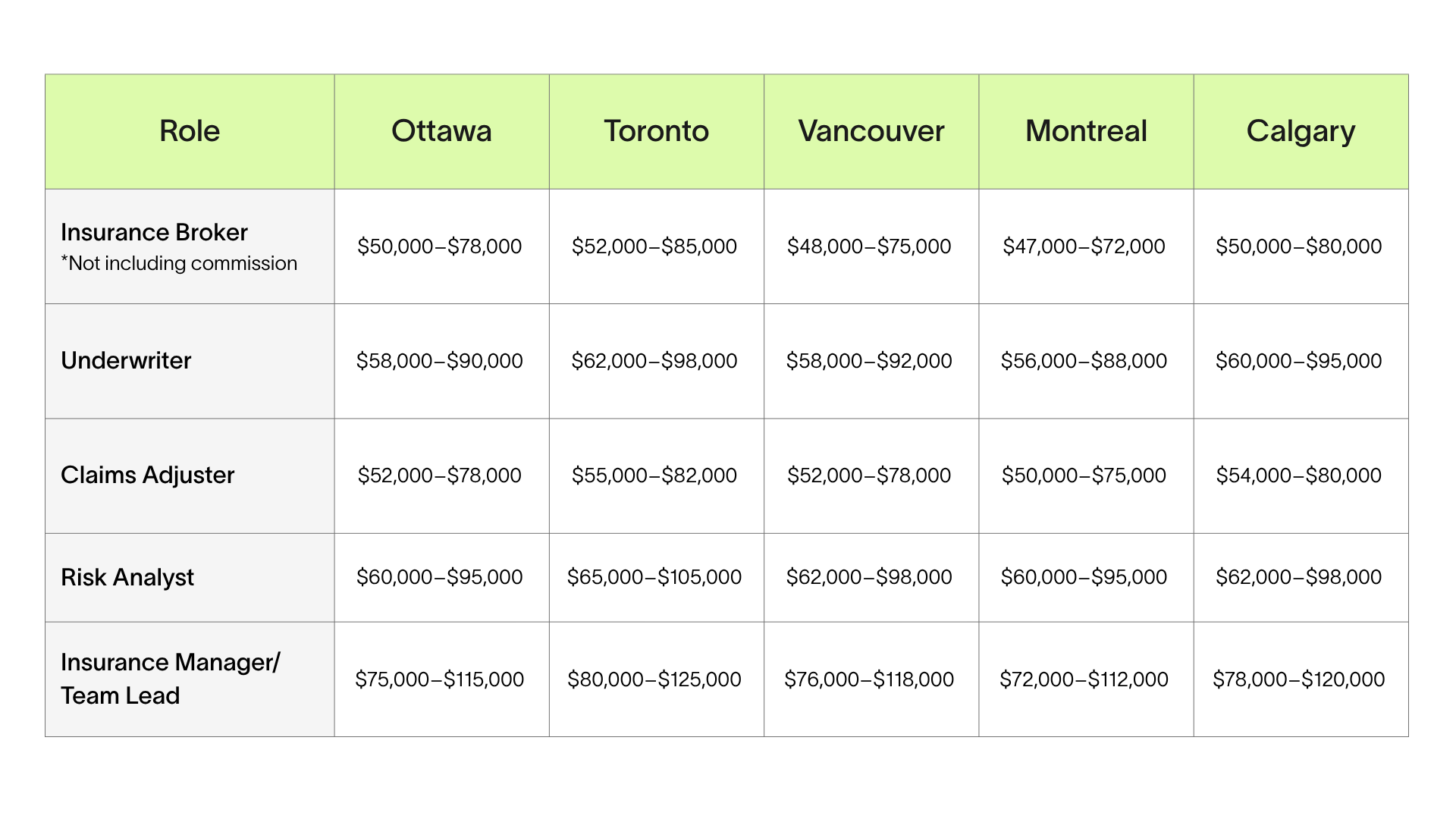
Curious what a career in insurance can look like from a compensation standpoint? Below is a look at salary data for five common roles, from early career to management, so you can see how earnings stack up across major cities in Canada.
To ensure accuracy, this data comes from Payfactors by Payscale, the compensation tool we trust to provide reliable market benchmarks for both candidates and employers.
Keep in mind that salaries can shift based on experience, designations (like CIP or FCIP), line of business, industry and whether the role is remote, hybrid or onsite.
Great insurance professionals aren't just risk experts; they're analytical, trustworthy people who help clients and businesses move forward with confidence.
If you're already working in insurance or exploring your first designation, this is a strong moment to grow. Roles in underwriting, claims and risk management continue to offer clear paths for advancement, strong compensation and the chance to do work that genuinely matters to the people you serve.
If you're considering your next move, now is the time to lean in, build your designation and step toward the future you want.
Ready for what's next? Explore open insurance roles on our Job Portal.
Related Reads:
How to Become a Top Accountant in Canada | Altis
How to Ace Your Job Search in 2026 | Altis
How to use LinkedIn to find a job and build your network | Altis

Altis is a Canadian-owned staffing firm supporting organizations across the private and public sectors. We focus on relationship-driven recruitment, clear process and consistent delivery, helping employers hire with confidence and professionals build meaningful careers.
.jpg)